Tankless vs. Traditional Water Heater
Tankless vs. Traditional: Which Water Heater Fits Your Home?
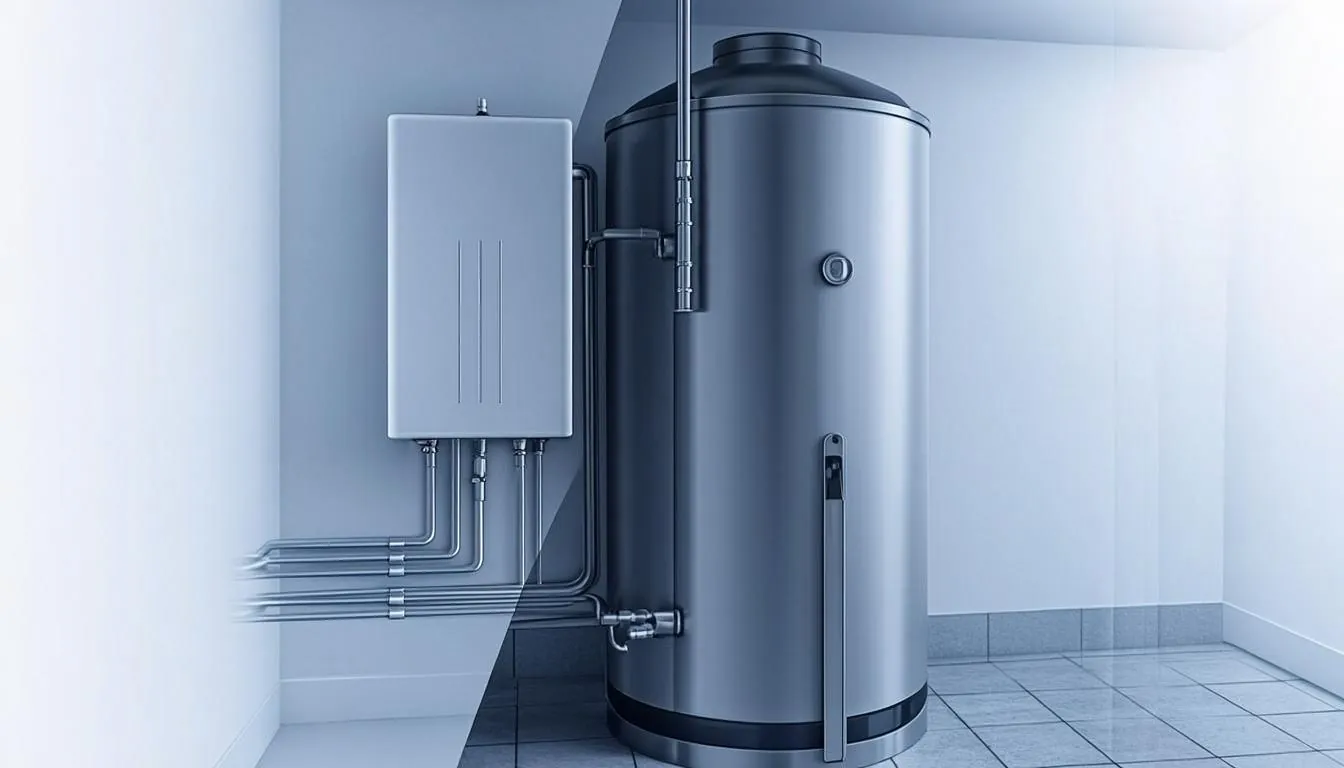
Illustrative image — a compact tankless unit and a traditional tank water heater shown side by side.
Every household eventually faces the same fork in the utility room: keep the familiar tank, or move to on-demand. Both paths work. Both paths disappoint when chosen for the wrong reasons. Here is the comparison the way installers actually think about it.
How Each Technology Delivers Hot Water
A traditional tank keeps a stored volume hot around the clock, then reheats as you draw it down. Its comfort ceiling is the first-hour rating plus recovery speed; its floor is running dry mid-shower on a busy morning. A tankless unit heats only when a fixture calls, and its comfort ceiling is flow capacity measured in gallons per minute; its floor is trying to feed more simultaneous fixtures than the burner or elements can serve, especially with cold winter inlet water.
Capacity: Stored Volume vs. Flow Rate
Households with stacked usage, back-to-back showers plus laundry plus dishes, punish a tank's recovery cycle. Households with spread-out usage may never notice the difference. Tankless sizing is an exercise in honesty about the worst minute of the day: what flows at once, and how cold is the water coming in. Our tankless sizing guide walks that arithmetic if you want to check any quote against it.
Efficiency and Operating Cost
Standby loss is the tank's built-in tax: stored water cools and reheats whether or not anyone opens a tap. Tankless units skip that loss, and condensing tankless models squeeze extra efficiency from exhaust heat. On the electric side, the biggest jump is not tankless at all: ENERGY STAR reports certified heat pump water heaters can save a household of four roughly $550 a year against a standard electric tank. Efficiency claims deserve context, though; fuel prices, usage patterns, and infrastructure costs all shape the payback. The honest framing appears in a written estimate, not a brochure.
Space, Infrastructure, and Installation Realities
Tanks need floor space and nothing exotic. Tankless units hang on a wall but impose infrastructure demands: gas line capacity and venting for gas models, dedicated high-amperage circuits for whole-house electric ones, and condensate drainage for condensing units. That gap is why a like-for-like tank swap is often a one-day job while a tank conversion is a planned project with permits. If a conversion is on your radar, the tank-to-tankless conversion page shows the full scope.
Maintenance and Service Life
Tanks care about anode rods and sediment; tanks care about the water chemistry feeding them, which in the Leesburg area varies between the town system, Loudoun Water service areas, and private wells. Tankless units care about descaling and filters. Neither technology survives neglect well, but each punishes a different kind of neglect, and maintenance schedules differ accordingly.
Side-by-Side Summary
| Factor | Traditional Tank | Tankless |
|---|---|---|
| Supply model | Stored volume plus recovery | On-demand flow capacity |
| Simultaneous use | Limited by first-hour rating | Limited by GPM and temperature rise |
| Standby loss | Present, always | None |
| Infrastructure needs | Venting or a circuit | Gas line capacity, venting, condensate, or heavy circuits |
| Space | Floor footprint | Wall-hung and compact |
| Core maintenance | Anode rod, sediment flush | Descale, filters, vent checks |
| Best fit | Proven, simple, quick swap | High demand, space needs, efficiency goals |
So Which One Belongs in Your Leesburg Home?
Start from constraints, not preferences. No gas service and a tight panel push you toward tank or heat pump options; a big household with gas service and growing demand makes tankless genuinely attractive; a rental turn or a quick sale makes the tank swap practical. Our tankless installation page and traditional tank page cover each path in depth, and a free written estimate puts your own numbers on the page.
The takeaway: There is no universal winner. Tankless rewards homes with rising demand and supporting infrastructure; tanks reward households that want proven, predictable, and quick. Let the infrastructure survey, not the showroom, make the call.