Tankless Error Codes
What Do Tankless Water Heater Error Codes Mean?
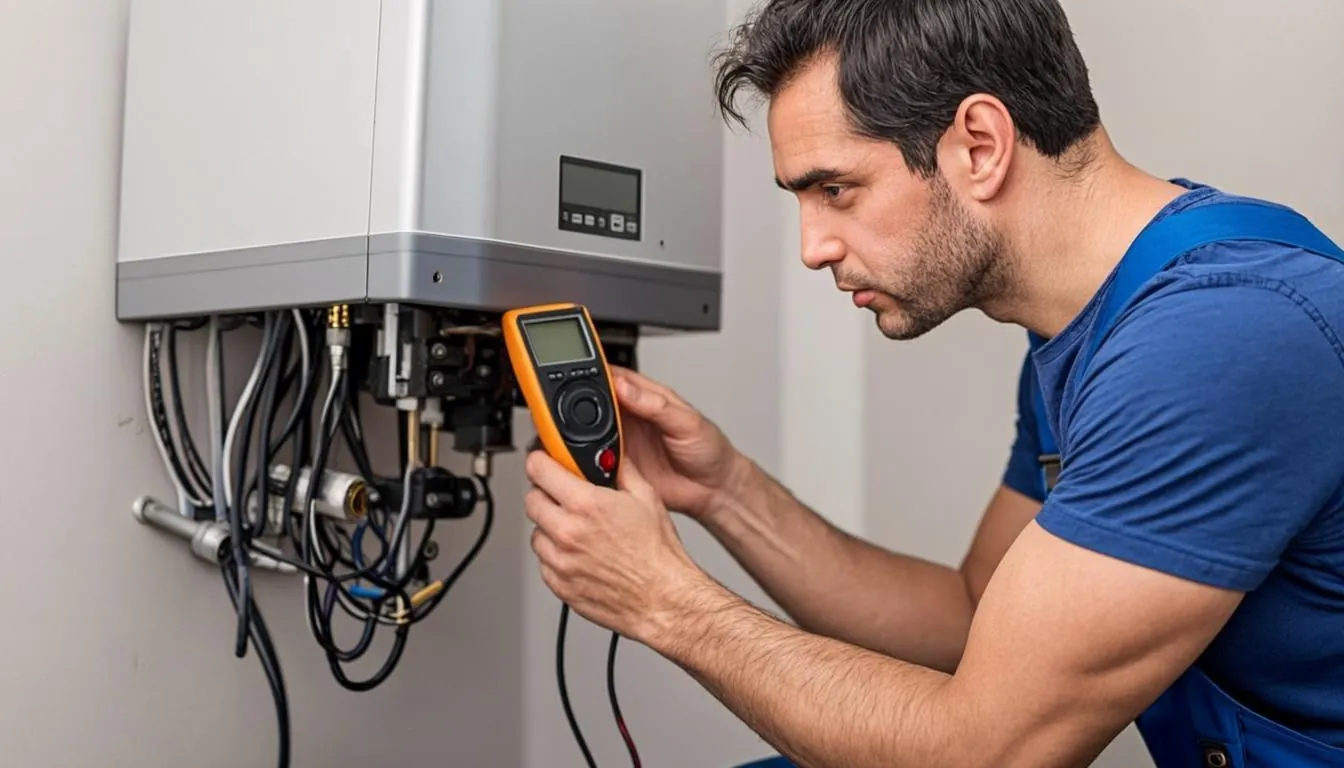
Illustrative image — a technician testing a tankless water heater with a multimeter during an error code diagnosis.
A tankless unit that senses trouble stops itself and displays a code. That code is not a verdict; it is a sentence in the unit's own language, and the dictionary lives in your model's manual. This guide teaches the grammar, so a flashing display becomes information instead of panic.
Why Units Display Codes at All
Modern tankless heaters monitor themselves continuously: flame presence, water flow, outlet temperature, exhaust conditions, and internal voltages all get watched. When a reading leaves its safe range, the control board halts operation and records why. Codes protect the equipment and the household, which is why resetting a unit repeatedly without diagnosing the cause is the one response this guide firmly discourages.
Find Your Model Number First
Codes are model-specific languages. The rating plate, usually on the unit's side or inside the front cover, gives the model and serial. With that, the manufacturer's troubleshooting chart for your series becomes the only chart worth reading; brand forums full of other models' codes send owners down wrong paths.
How the Major Brands Organize Codes
Rinnai's diagnostic system
Rinnai publishes a dedicated troubleshooting manual listing diagnostic codes by series, with each code pointing to a checklist of causes and observations. The company's charts are the authority for your specific unit, and the safe checks they list come before any component talk.
Navien's code families
Navien groups codes into families around ignition, flame, overheating, and sensor faults. Their manuals pair each code with recommended observations, and the distinction between a safe check and a service call is printed right there.
Noritz's documented codes
Noritz publishes explanations for its common codes directly. Two examples from their own documentation: code 11 signals an ignition failure, meaning the unit sensed demand but could not light the burner; code 90 signals a combustion abnormality, where the fuel-air mix has drifted out of specification and combustion quality has dropped.
Source: Noritz knowledge base, error code 11 and Noritz common error codes.
Other brands follow the same pattern
Rheem and other manufacturers publish equivalent charts. The vocabulary differs; the grammar of ignition, flame, flow, overheat, and sensor faults repeats across all of them.
Reading the Patterns, Not Just the Number
| Code family | What it usually signals | Safe homeowner check | Professional action |
|---|---|---|---|
| Ignition failure | Gas supply or igniter could not light the burner | Confirm gas valve open, other gas appliances working | Ignition system diagnosis, gas pressure test |
| Flame failure | Burner lit but proof of flame was lost | Note when it happens: every use or intermittent | Flame sensing and gas valve diagnostics |
| Overheat | Exchanger ran hotter than safe limits | Check for scale history and recent flow changes | Descaling, sensor and safety-circuit testing |
| Flow fault | Flow sensor reading outside expected range | Clean the inlet screen if the manual lists it | Sensor testing, filter and pump inspection |
| Combustion abnormality | Fuel-air mix drifted out of specification | Nothing safe; note the code and call | Combustion analysis and adjustment |
| Condensate fault | Condensate path blocked on condensing models | Look for standing water at the unit | Line clearing and neutralizer service |
Reading Error History
Many models store recent fault history accessible from the panel, and technicians read it like a medical chart: which codes, how often, in what season. History separates a one-time glitch from a repeating pattern, and patterns drive repair decisions, as our lifespan guide explains.
When a Professional Technician Is Required
Anything touching gas valves, burners, igniters, safety circuits, or internal sensors belongs with a qualified technician carrying the right instruments. Combustion analysis, pressure testing, and safety-circuit verification are not DIY territory, and this guide will never suggest bypassing or disabling a protective fault.
Repair or Replace After the Code
Some codes resolve with descaling and filters; others announce failing components. When the diagnosis lands in the second category, the repair page explains the fix path and the replacement page prices the alternative, side by side in writing. The maintenance team prevents the next code, and the phone line above it answers any hour a display starts flashing.
The takeaway: Error codes are a language, and your model's manual is the dictionary. Translate first, check the safe items, and leave gas, burner, and safety-circuit work to a technician with the right instruments.