Hard Water and Tankless Heaters
Does Hard Water Damage a Tankless Water Heater?
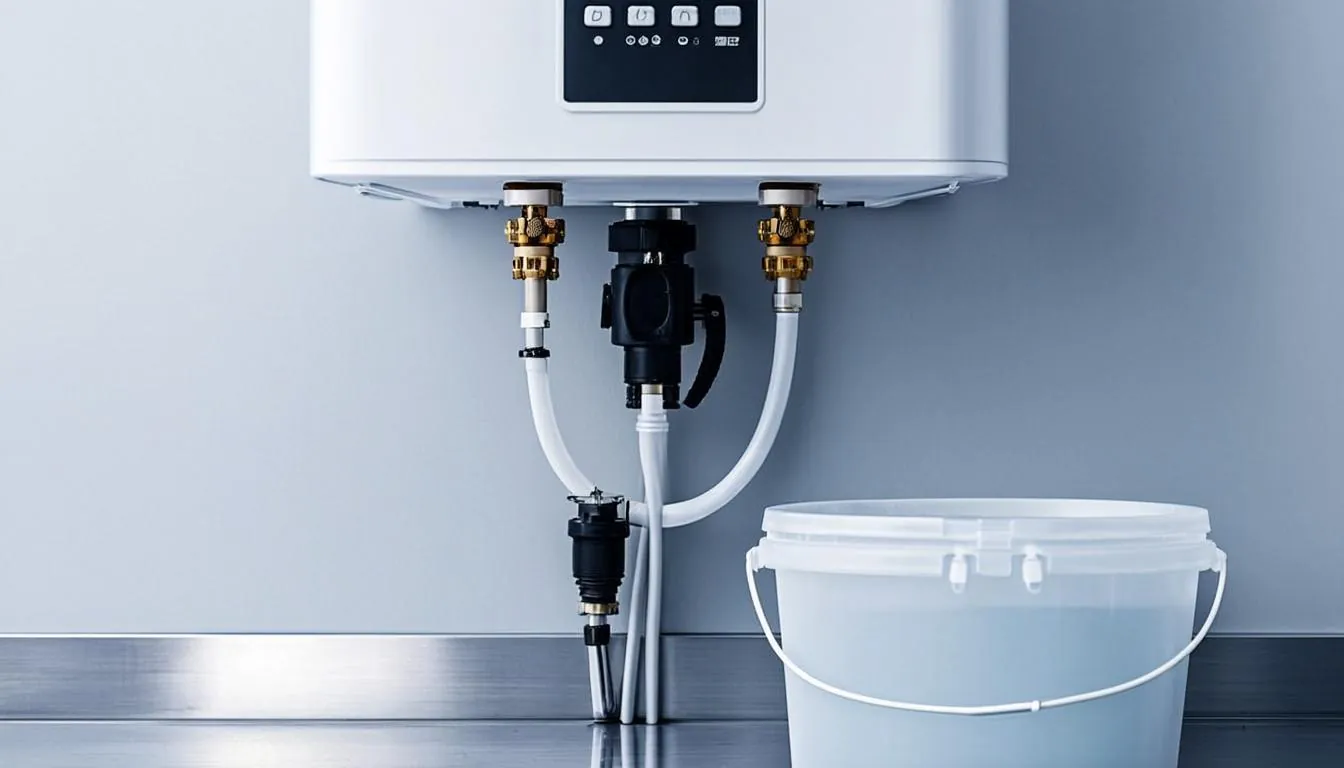
Illustrative image — mineral scale inspected inside a tankless water heater during maintenance.
Ask a tankless technician what kills equipment, and the answer comes back instantly: scale. Hard water itself is harmless to drink; inside a heat exchanger it is a slow-motion failure mechanism. Understanding the chemistry is the first step to neutralizing it.
What Hard Water Actually Is
Hardness is dissolved calcium and magnesium picked up as water moves through rock and soil. Concentration varies by source: municipal systems draw from surface water and wells of differing mineral content, and private wells add their own signatures. Nothing about hardness makes water unsafe; it makes water thermodynamically ambitious, eager to drop its minerals the moment temperature and pressure conditions change.
Why Heat Exchangers Attract the Deposits
Heating encourages dissolved minerals to come out of solution and plate onto hot surfaces as calcium carbonate scale. A tankless heat exchanger is precisely such a surface, with narrow passages and intense heat flux. The deposits insulate the wall from the water, so the unit runs hotter to achieve the same output, which deposits more scale, which insulates further. The loop feeds itself.
What the Damage Looks Like Day to Day
- Output fading gradually despite normal settings
- Temperatures wobbling where they used to hold steady
- Error codes tied to overheat or flow conditions appearing seasonally
- Noise from the unit as flow fights through roughened passages
Left unaddressed, the endpoint is an exchanger whose restriction or damage outlasts descaling, which converts a maintenance problem into a replacement conversation.
Testing Before Treating
Hardness is measurable, cheaply, and the result sets every strategy that follows. Municipal customers start with their provider's annual water quality report; our Leesburg water hardness guide walks through reading local reports without over-reading them. Well owners should test directly: Loudoun County runs a household water quality testing program covering wells, cisterns, and springs at low cost, and the data beats any assumption.
Source: Loudoun County household water testing program.
Softener vs. Scale Prevention, Compared
Water softeners exchange hardness minerals for sodium or potassium, protecting the whole home and every fixture that touches water. Scale-prevention systems treat water at the equipment's point of entry, targeting the exchanger specifically with a smaller footprint and lower cost. The right choice follows your test results, budget, and household preferences, and we price both options honestly when the data calls for one.
Flushing: The Maintenance That Answers Hardness
Whatever the treatment strategy, periodic descaling remains the mechanical reset. A flush circulates solution through the exchanger, dissolving early deposits before they harden into problems. Intervals should follow your tested water and manufacturer guidance rather than a universal calendar; our flushing frequency guide explains how to set it, and the maintenance page books the service. When scale has already cost performance, the repair team restores what can be restored, any hour the phone rings.
The takeaway: Hard water is the single biggest threat to a tankless heat exchanger, and it is also the most manageable. Test the water, match flushing to the result, and the damage curve flattens dramatically.